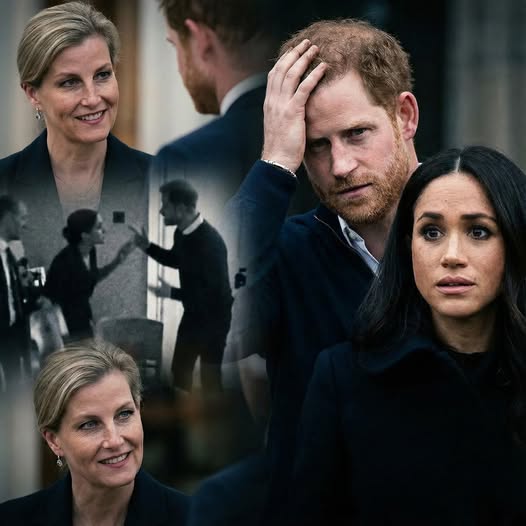
In the era of clickbait and social media firestorms, certain headlines have an almost instant impact — and the recent viral claim that a dramatic on-air clash “ended” Meghan Markle’s hopes of a royal comeback is a perfect example.
The original headline — “THE ROYAL FANTASY IS DEAD — AND TONIGHT, EVERYBODY SAW WHO SWUNG THE FINAL AXE” — reads like something out of a gladiatorial arena. Duchess Sophie, Meghan Markle, Prince Harry: these are names that dominate tabloid attention, and when combined with language like “final blow,” “no one cares anymore,” the result is a story built more for shock value than substantiated reporting.
But what’s really going on?
The Anatomy of a Sensational Headline
It’s worth breaking down the elements that make this headline so compelling:
-
High stakes language: Words like “dead,” “final axe,” “swing,” and “fire” evoke violence and closure.
-
Familiar characters: Meghan Markle and Prince Harry remain perennial tabloid figures. Adding a royal figure — here “Duchess Sophie” — gives the story instant context.
-
Conflict and emotion: The suggestion of an on-air confrontation, emotional reactions, and definitive endings are exactly the elements that drive clicks.
But headlines are not reporting. They are advertising copy designed to make you click.
What’s Verifiable — and What Isn’t
As of now, there is no credible evidence from reputable news outlets that Meghan Markle has been publicly confronted on live television by a member of the royal family, nor that any “final blow” was struck that ends her place in the public eye.
Royal commentators and mainstream media have long noted that tabloids often recycle narratives about tensions within the monarchy, especially involving the Sussexes, but such stories rarely reflect confirmed events.
In this case:
-
There is no official record of the on-air confrontation described.
-
Quotes such as “This ends here — you don’t get to rewrite history” and “No one even cares anymore” cannot be verified.
-
The alleged emotional reactions of Harry and Meghan are drawn from social media speculation, not direct reporting.
So why does this story spread?
Why Viral Royal Stories Persist
Royal family narratives — especially involving Meghan and Harry — have become a modern mythology of sorts. Audiences are drawn to:
-
Conflict: Stories of tension sell.
-
Inclusion vs. entitlement debates: Discussions around Meghan’s role in the royals touch on broader cultural conversations about class, race, and modern monarchy.
-
Unresolved narratives: Unlike scripted drama, real life has ambiguity — and ambiguity fuels speculation.
That means even when a story is unverified, the emotional resonance can keep it alive.
The Role of Responsible Consumption
As consumers of news — especially on social media — it’s vital to distinguish between verified reporting and viral speculation. Sensational headlines often:
-
Take familiar names and amplify conflict.
-
Use dramatic language to increase engagement.
-
Blur the line between opinion and fact.
Responsible outlets will clearly cite sources, provide context, and avoid presenting unverified claims as truths.
Conclusion: Sensation vs. Reality
The headline “ROYAL FANTASY IS DEAD” functions as compelling marketing, not factual reporting. There is no substantiated evidence of a televised confrontation or a definitive end to Meghan Markle’s public narrative.
What the story does reveal, however, is the enduring fascination with the British royal family and the way media — both traditional and social — shape discourse around personal and institutional conflict.
In a world hungry for drama, the real mystery may not be “who swung the final axe,” but why we’re so eager to believe it.